


Multiple intelligences
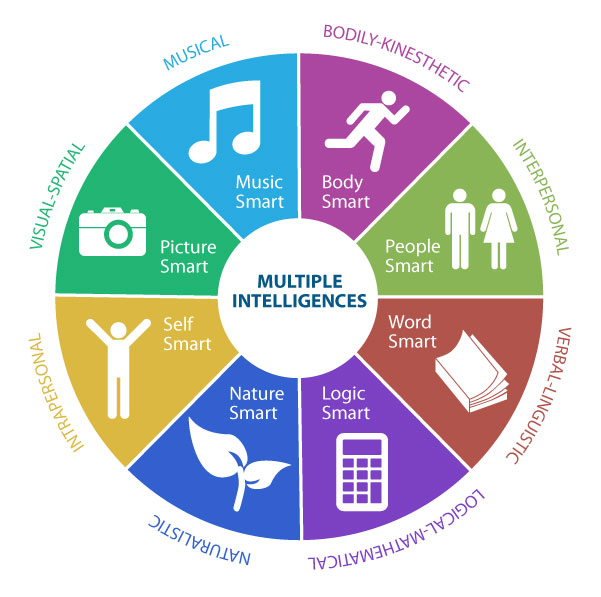
Logical (Mathematical)
Children who display an aptitude for numbers, reasoning and problem solving. This is the other half of the children who typically do well in traditional classrooms where teaching is logically sequenced and students are asked to conform.
Musical (Rhythmic)
Children who learn well through songs, patterns, rhythms, instruments and musical expression. It is easy to overlook children with this intelligence in traditional education.
Naturalist
Children who learn well through songs, patterns, rhythms, instruments and musical expression. It is easy to overlook children with this intelligence in traditional education.
Intrapersonal
Children who are especially in touch with their own feelings, values and ideas. They may tend to be more reserved, but they are actually quite intuitive about what they learn and how it relates to themselves.
Visual (Spatial)
Children who learn best visually and organizing things spatially. They like to see what you are talking about in order to understand. They enjoy charts, graphs, maps, tables, illustrations, art, puzzles, and costumes - anything eye catching.
Verbal (Linguistic… to do with words)
Children who demonstrate strength in the language arts: speaking, writing, reading, listening. These students have always been successful in traditional classrooms because their intelligence lends itself to traditional teaching.
Kinesthetic (Bodily)
Children who experience learning best through activity: games, movement, hands-on tasks, building. These children were often labeled "overly active" in traditional classrooms where they were told to sit and be still!
Interpersonal
Children who are noticeably people oriented and outgoing, and do their learning cooperatively in groups or with a partner. These children may have typically been identified as "talkative" or " too concerned about being social" in a traditional setting.